Skip to chaptersAll presentations19 CHAPTERS / COMPLETE PRESENTATION
AGRONAMA — company, farming & markets
Organized in the original slide order. Source images and original text are preserved beneath every chapter.
CHAPTER 01
Organic Approach to Healthy Future
- AGRONAMA introduces an organic approach to a healthy future. The cover combines English and Arabic branding, leafy crops and a Bahrain map.
Original slide & reference text
Original English transcript
Organic Approach to healthy future
CHAPTER 02
About AGRONAMA
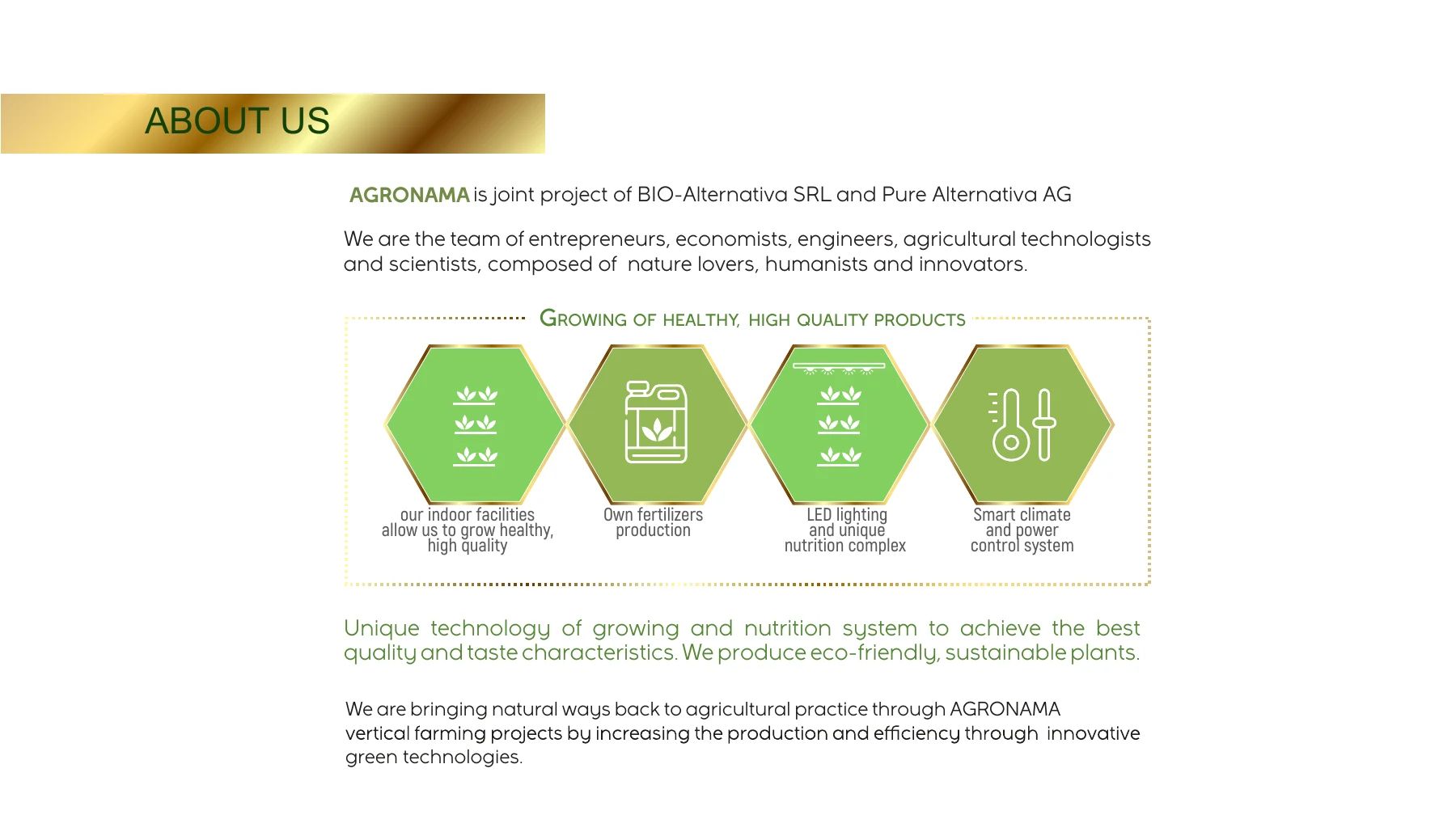
- A joint project of BIO-Alternativa SRL and Pure Alternativa AG.
- The team comprises entrepreneurs, economists, engineers, agricultural technologists and scientists: nature lovers, humanists and innovators.
- The mission is to bring natural methods back into agriculture through green technologies, pursuing high quality, taste and environmentally friendly, sustainable plants.
- The system combines indoor growing facilities, own fertilizer production, LED lighting, a unique nutrition complex, and smart climate and power control.
Original slide & reference text
Original English transcript
We are bringing natural ways back to agricultural practice through AGRONAMA
green technologies.
Unique technology of growing and nutrition system to achieve the best
quality and taste characteristics. We produce eco-friendly, sustainable plants.
ABOUT US
Own fertilizers
production
our indoor facilities
allow us to grow healthy,
high quality
LED lighting
and unique
nutrition complex
Smart climate
and power
control system
GROWING OF HEALTHY, HIGH QUALITY PRODUCTS

We are the team of entrepreneurs, economists, engineers, agricultural technologists
and scientists, composed of nature lovers, humanists and innovators.
ABOUT US
is joint project of BIO-Alternativa SRL and Pure Alternativa AGAGRONAMA
CHAPTER 03
What is vertical farming?
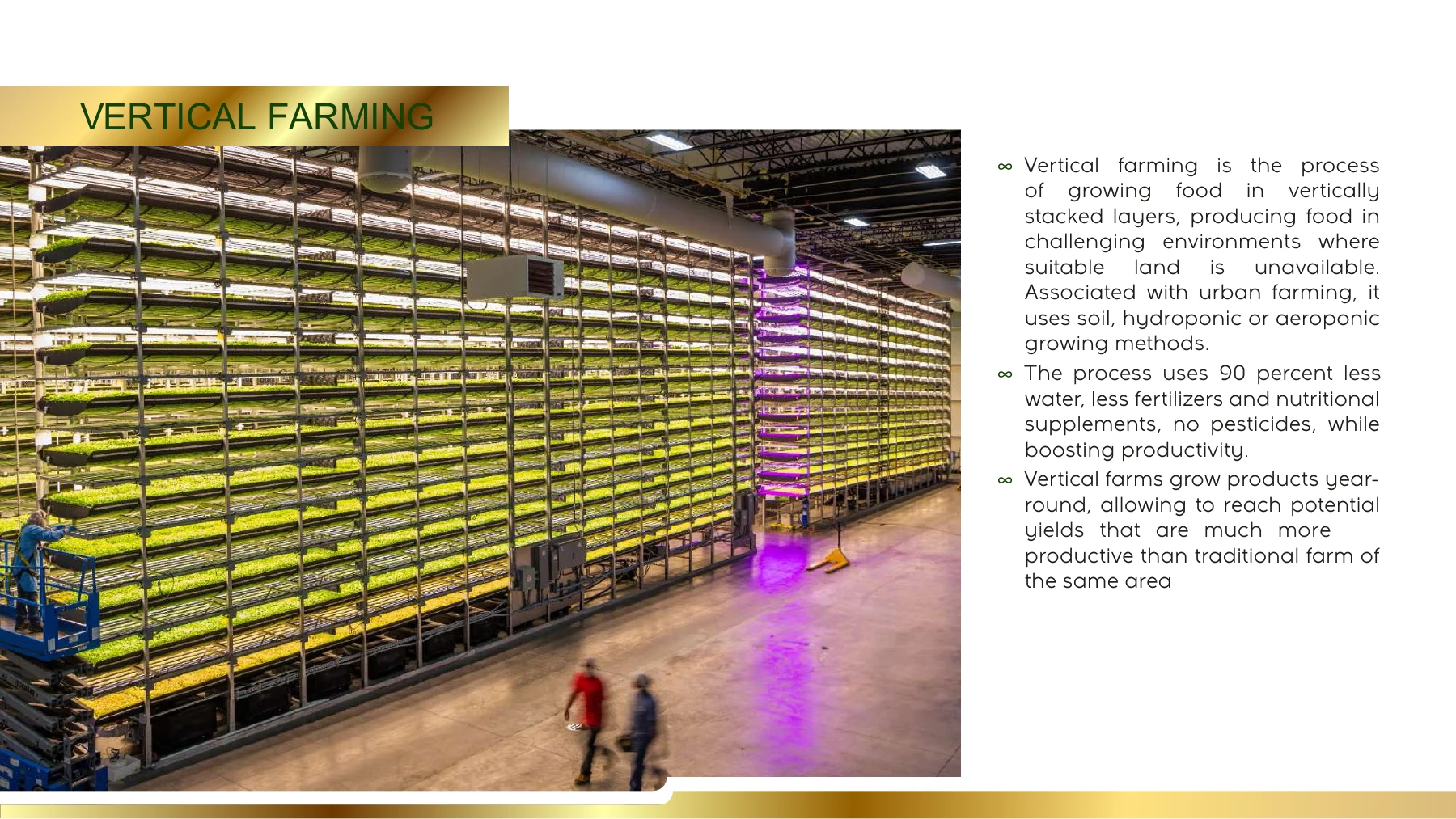
- Food is grown in vertically stacked layers, including where suitable land is unavailable.
- Associated with urban farming, it can use soil, hydroponic or aeroponic methods.
- The source claims 90% less water, reduced fertilizers and supplements, and no pesticides while increasing productivity.
- Year-round growing is presented as offering greater potential yield than traditional farming on the same ground area.
Original slide & reference text
Original English transcript
∞ Vertical farming is the process
of growing food in vertically
stacked layers, producing food in
challenging environments where
suitable land is unavailable.
Associated with urban farming, it
uses soil, hydroponic or aeroponic
growing methods.
 ∞ The process uses 90 percent less
water, less fertilizers and nutritional
supplements, no pesticides, while
boosting productivity.
 ∞ Vertical farms grow products year-
round, allowing to reach potential
yields that are much more
productive than traditional farm of
the same area
VERTICAL FARMING
CHAPTER 04
Agricultural challenges
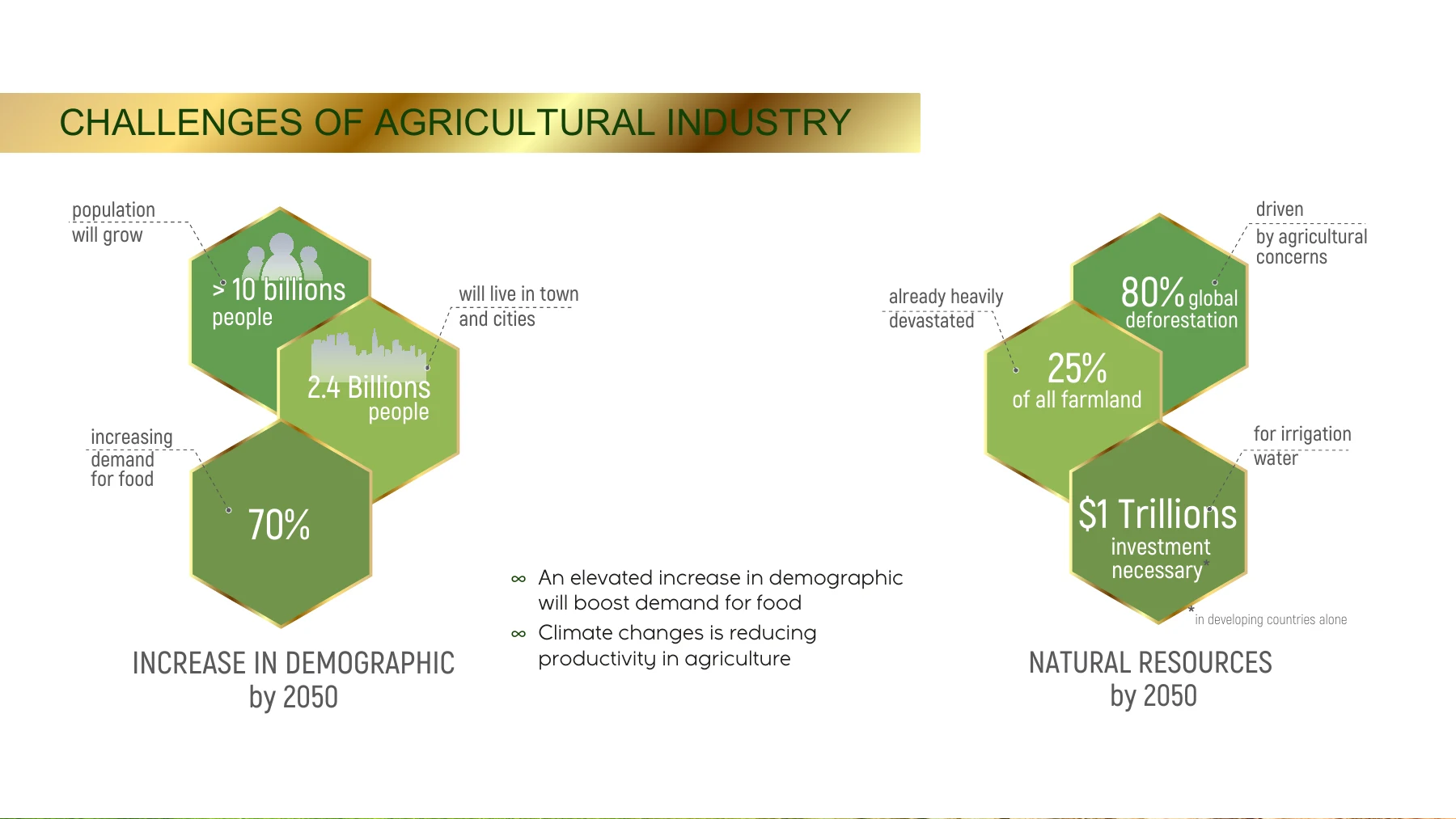
- Population growth increases food demand, while climate change reduces agricultural productivity.
- The source’s demographic and resource indicators are listed in the table.
Source indicators| Indicator | Value |
|---|
| Population by 2050 | >10 billion people |
|---|
| People in towns and cities | 2.4 billion |
|---|
| Increase in food demand | 70% |
|---|
| Heavily degraded farmland | 25% |
|---|
| Agriculture-driven global deforestation | 80% |
|---|
| Irrigation investment needed by 2050 | $1 trillion in developing countries alone |
|---|
The underlying sources and baseline for the 2.4-billion urban figure are not identified. Figures are reproduced as printed.
Original slide & reference text
Original English transcript
CHALLENGES OF AGRICULTURAL INDUSTRY
population
will grow
70%
increasing
demand
for food
will live in town
and cities
> 10 billions> 10 billions
2.4 Billions
people
people
INCREASE IN DEMOGRAPHIC
by 2050
already heavily
devastated
for irrigation
water
$1 Trillions
80%
25%
driven
by agricultural
concerns
investment
necessary*
NATURAL RESOURCES
by 2050
of all farmland
global
deforestation
*in developing countries alone
 ∞ An elevated increase in demographic
will boost demand for food
 ∞ Climate changes is reducing
productivity in agriculture
CHAPTER 05
Drivers and benefits
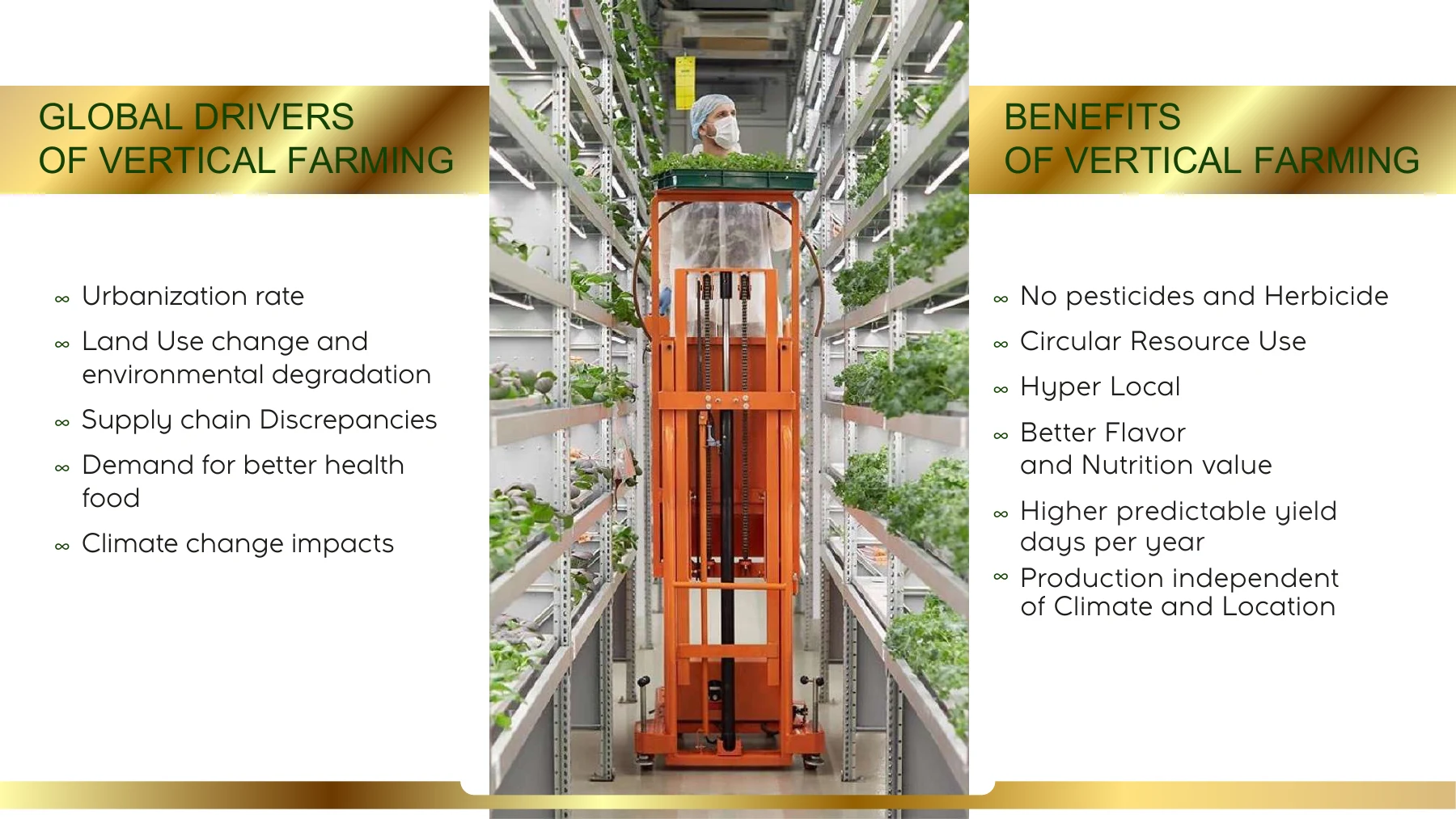
- Drivers: urbanisation; land-use change and environmental degradation; supply-chain discrepancies; demand for healthier food; climate-change impacts.
- Claimed benefits: no pesticides or herbicides; circular resource use; hyper-local production; better flavour and nutritional value; higher predictable yields.
- Production is presented as independent of climate and location, throughout the year.
Original slide & reference text
Original English transcript
∞ No pesticides and Herbicide
 ∞ Circular Resource Use
 ∞ Hyper Local
 ∞ Better Flavor
and Nutrition value
 ∞ Higher predictable yield
days per year
Production independent
of Climate and Location

 ∞ Urbanization rate
 ∞ Land Use change and
environmental degradation
 ∞ Supply chain Discrepancies
 ∞ Demand for better health
food
 ∞ Climate change impacts
∞
GLOBAL DRIVERS
OF VERTICAL FARMING
BENEFITS
OF VERTICAL FARMING
CHAPTER 06
Hydroponics, vertical farming and the EU
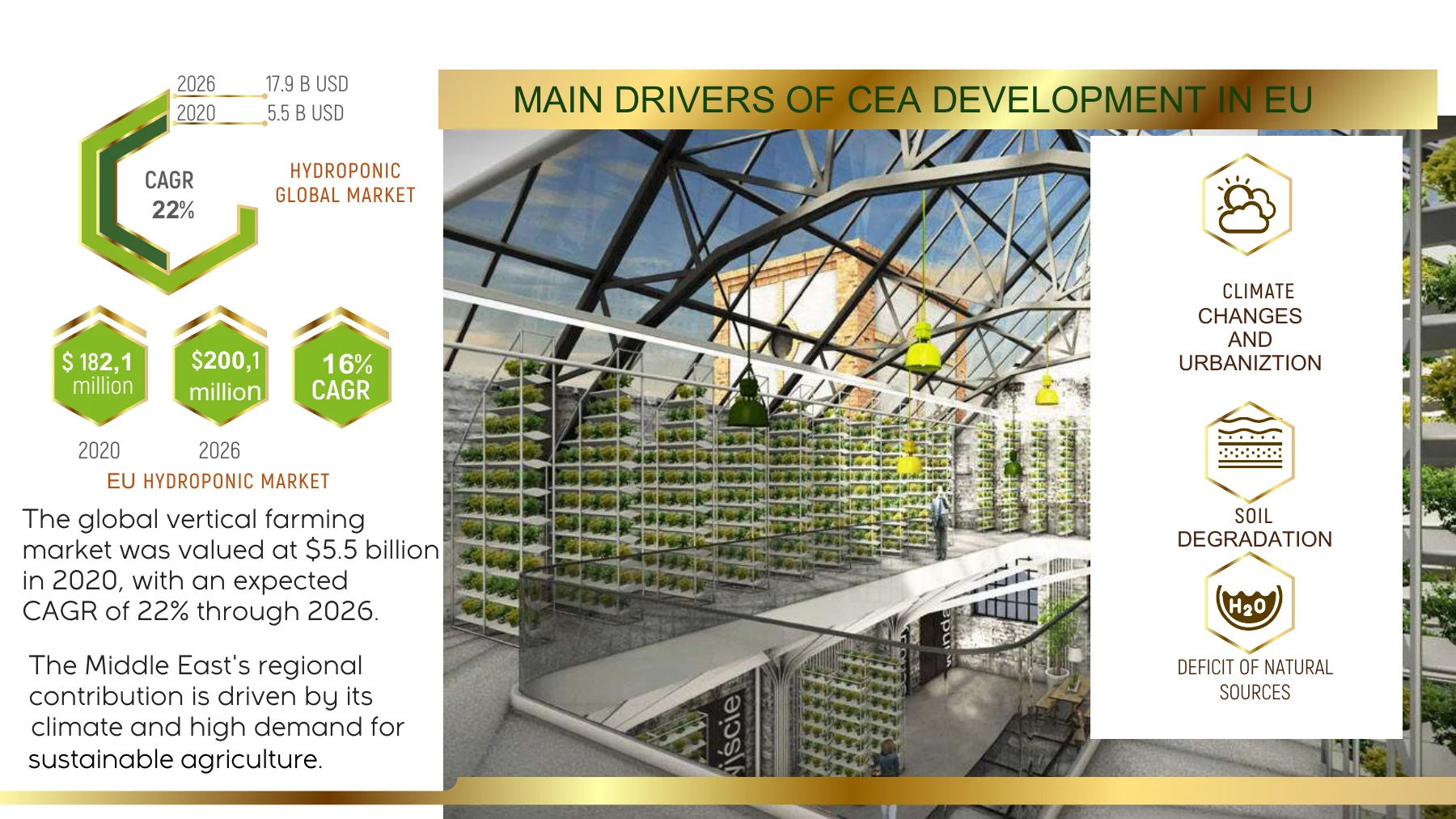
- EU drivers: scarcity of natural resources, soil degradation, climate change and urbanisation.
- The Middle East contribution is linked to its climate and demand for sustainable agriculture.
- The global graphic is labelled hydroponics, but the accompanying text describes the same figures as vertical farming.
Market figures as printed| Market | 2020 | 2026 forecast | Stated CAGR |
|---|
| Global hydroponics / vertical farming | $5.5 billion | $17.9 billion | 22% |
|---|
| EU hydroponics | $182.1 million | $200.1 million | 16% |
|---|
Historical forecasts. Neither stated CAGR reconciles exactly with its endpoints; the EU discrepancy is substantial.
Original slide & reference text
Original English transcript
HYDROPONIC

GLOB AL M ARKET
2026
5.5 B USD
17.9 B USD
2020
CAGR
22%
2020


16%
CAGR
$ 182,1
million
$200,1
million
2026
EU HYDRO PONIC  MARK ET
DEFICIT OF NATURAL
SOURCES
      SOIL
DEGRADATION
CLIMA TE
CHANGES
AND
URBANIZTION
The global vertical farming
market was valued at $5.5 billion
in 2020, with an expected
CAGR of 22% through 2026.
The Middle East's regional
contribution is driven by its
climate and high demand for
sustainable agriculture.
MAIN DRIVERS OF CEA DEVELOPMENT IN EU
CHAPTER 07
Freshness and the consumer
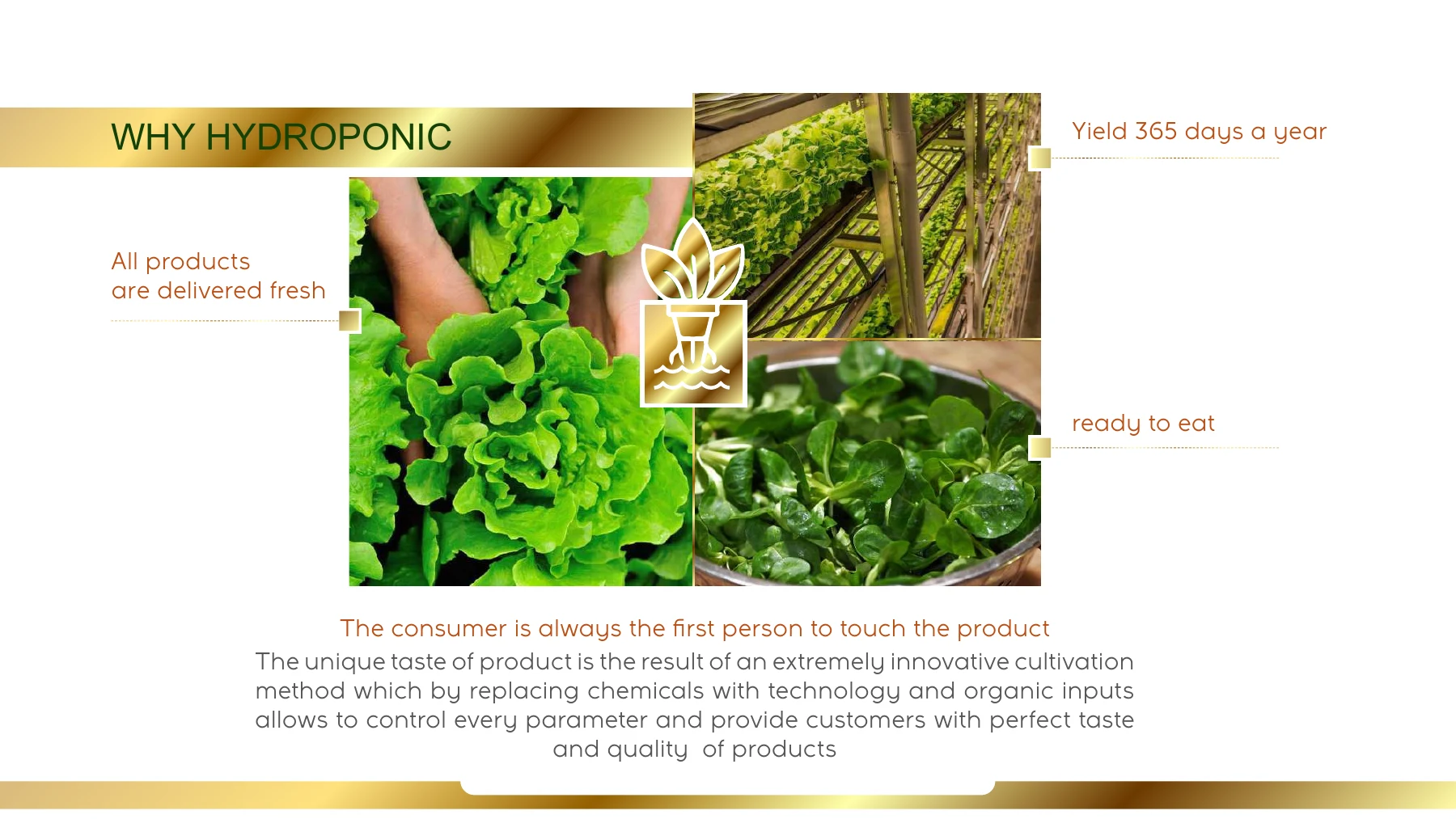
- Harvests 365 days a year; fresh, ready-to-eat products.
- The presentation states that the consumer is the first person to touch the product.
- Replacing chemicals with technology and organic inputs allows control of cultivation parameters to pursue taste and quality.
Original slide & reference text
Original English transcript
All products
are delivered fresh
Yield 365 days a year
ready to eat
The consumer is always the first person to touch the product
The unique taste of product is the result of an extremely innovative cultivation
method which by replacing chemicals with technology and organic inputs
allows to control every parameter and provide customers with perfect taste
and quality  of products
WHY HYDROPONIC
CHAPTER 08
Hydroponic performance claims
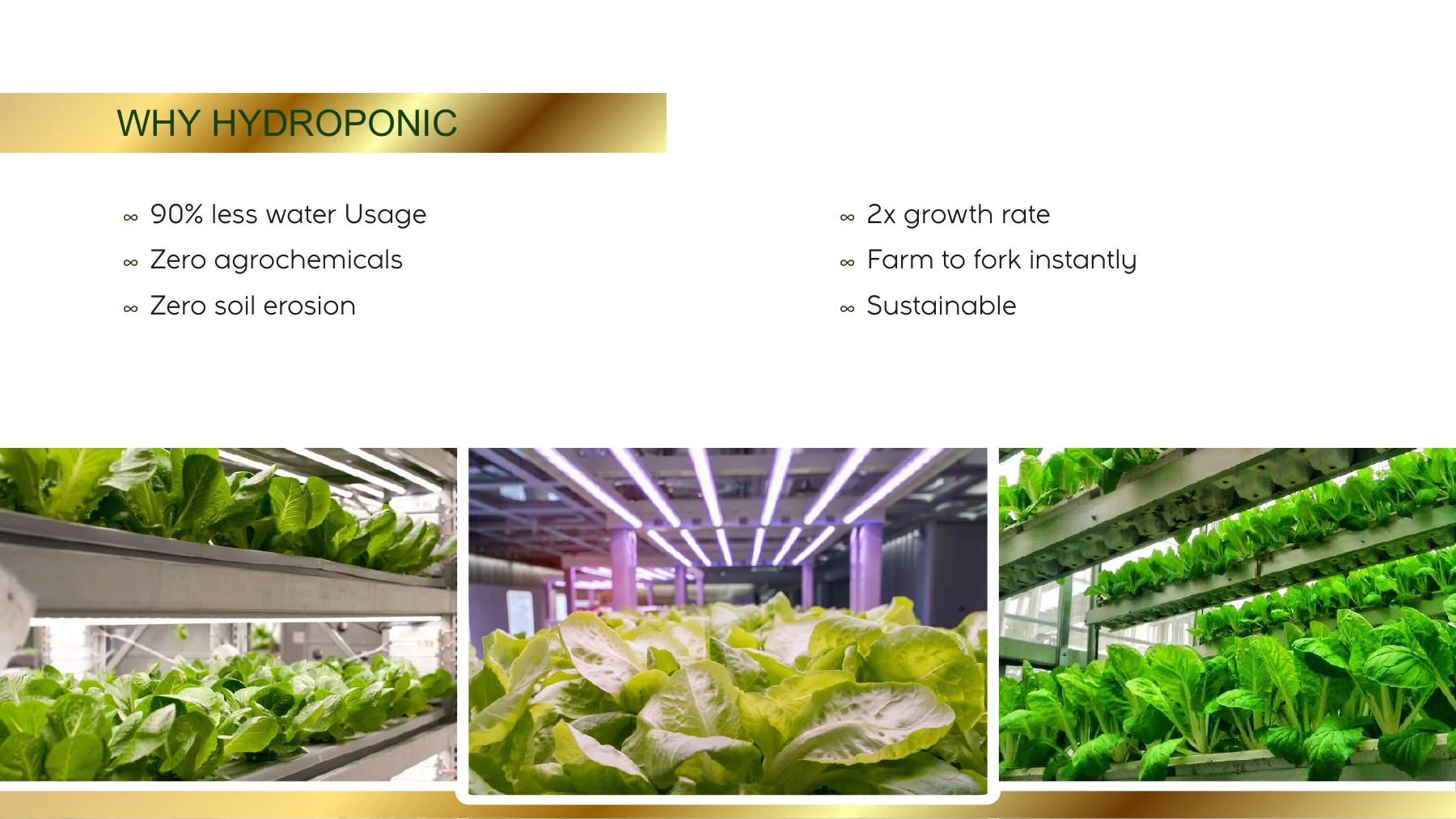
- 90% less water usage.
- Zero agrochemicals.
- Zero soil erosion.
- 2× growth rate.
- Immediate farm-to-fork availability.
- Sustainable cultivation.
Source claims; the crop, comparator, trial design and operating conditions are not supplied.
Original slide & reference text
Original English transcript
∞ 90% less water Usage
 ∞ Zero agrochemicals
 ∞ Zero soil erosion
 ∞ 2x growth rate
 ∞ Farm to fork instantly
 ∞ Sustainable
WHY HYDROPONIC
CHAPTER 09
Vertical farming technology
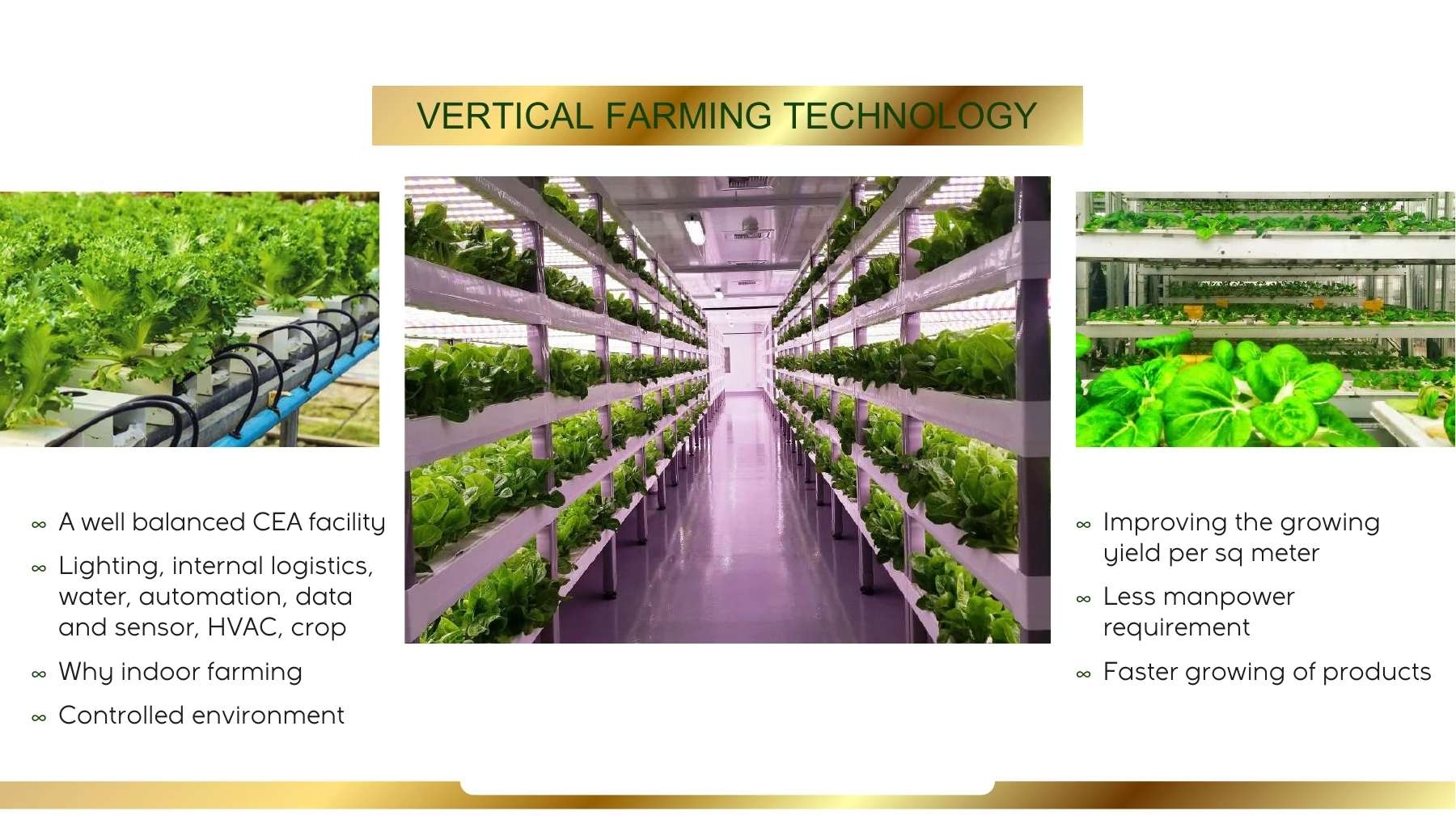
- A balanced CEA facility integrates lighting, internal logistics, water, automation, data, sensors, HVAC and crops.
- Indoor farming provides a controlled environment.
- Objectives: higher yield per square metre, less labour and faster crop growth.
Original slide & reference text
Original English transcript
∞ A well balanced CEA facility
 ∞ Lighting, internal logistics,
water, automation, data
and sensor, HVAC, crop
 ∞ Why indoor farming
 ∞ Controlled environment

 ∞ Improving the growing
yield per sq meter
 ∞ Less manpower
requirement
 ∞ Faster growing of products
VERTICAL FARMING TECHNOLOGY
CHAPTER 10
Key components of indoor farming
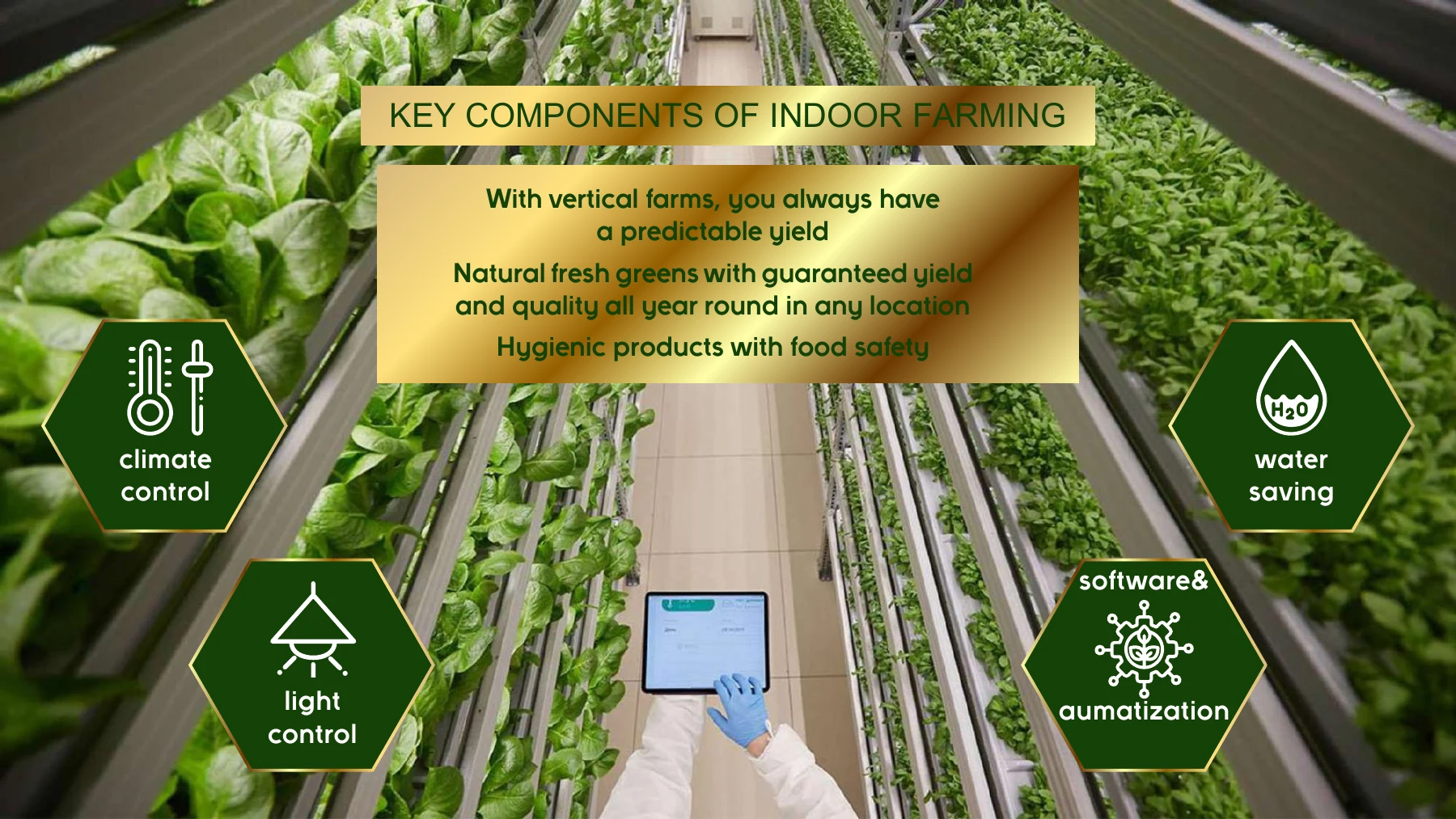
- Climate control; water saving; light control; software and automation.
- The source promises predictable yields, natural fresh greens with year-round quality in any location, and hygienic products with food safety.
These are source objectives, not a site-issued production or food-safety guarantee.
Original slide & reference text
Original English transcript
climate
control
water
saving
With vertical farms, you always have
a predictable yield
Natural fresh greens with guaranteed yield
and quality all year round in any location
Hygienic products with food safety
KEY COMPONENTS OF INDOOR FARMING
light
control
software&
aumatization
CHAPTER 11
Operating benefits
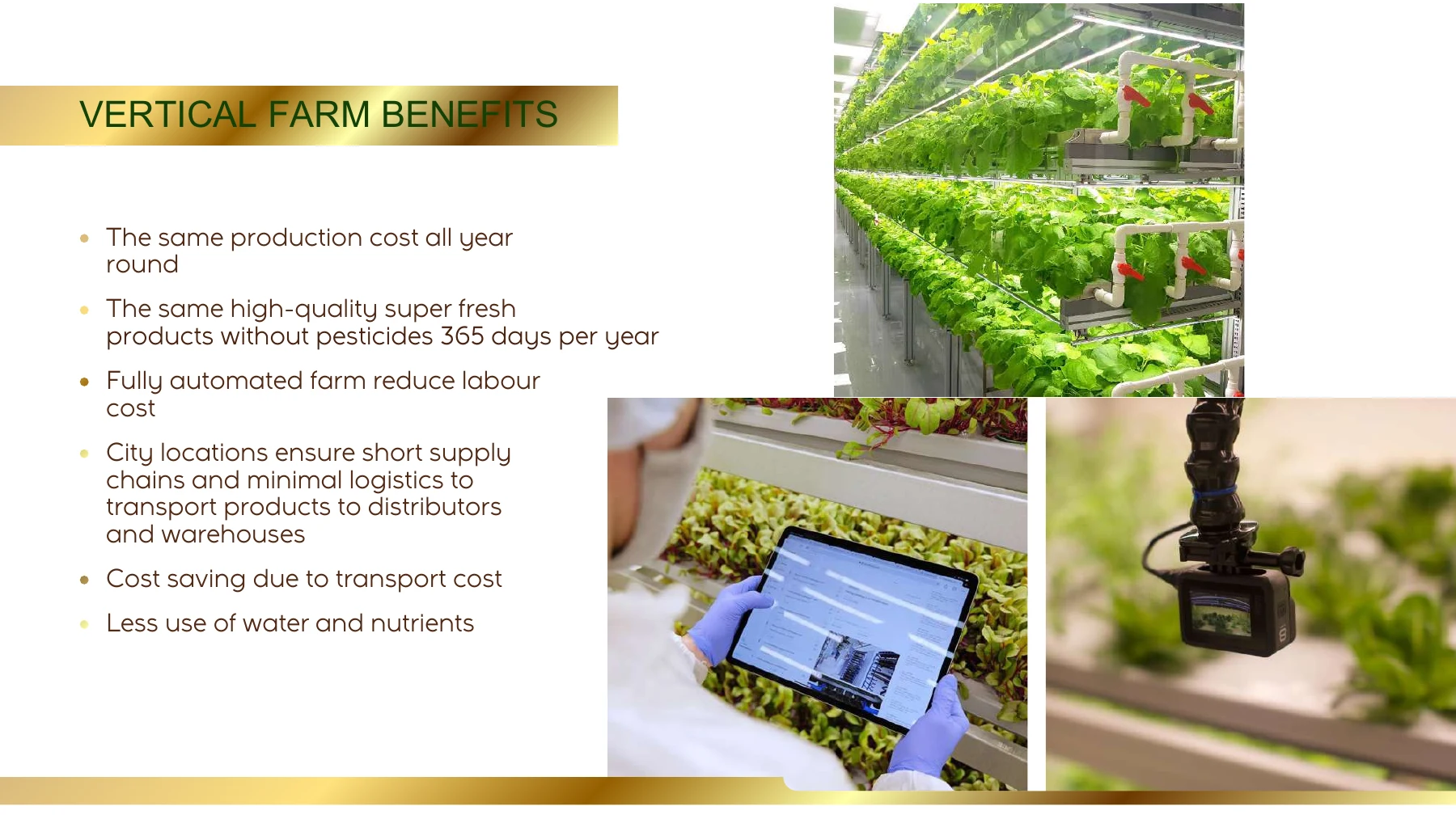
- Stable production cost year-round.
- Consistent high-quality, very fresh products without pesticides, 365 days per year.
- Automation reduces labour costs.
- Urban locations shorten supply chains and logistics to distributors and warehouses.
- Reduced transport cost and lower water and nutrient use.
Original slide & reference text
Original English transcript
The same production cost all year
round
 The same high-quality super fresh
products without pesticides 365 days per year
 Fully automated farm reduce labour
cost
 City locations ensure short supply
chains and minimal logistics to
transport products to distributors
and warehouses
 Cost saving due to transport cost
 Less use of water and nutrients
VERTICAL FARM BENEFITS
CHAPTER 12
Companies in the presentation
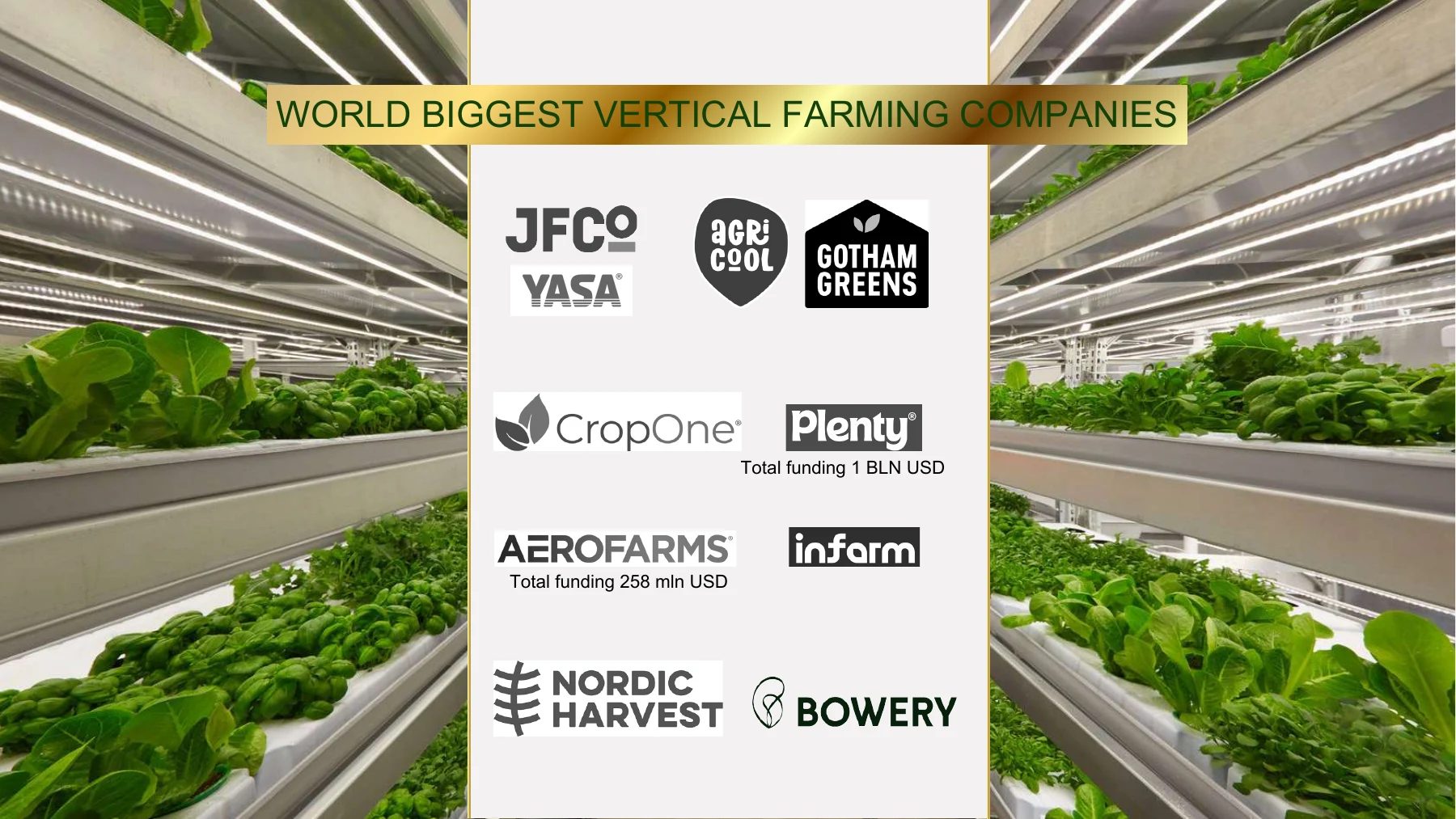
- JFCo (Jones Food Company), YASAI, Agricool, Gotham Greens, Crop One, Plenty, AeroFarms, Infarm, Nordic Harvest and Bowery.
- Funding stated: AeroFarms USD 258 million; Plenty USD 1 billion.
Historical examples, not a current ranking, partnership statement or confirmation of present operating status.
Original slide & reference text
Original English transcript
Total funding 258 mln USD
Total funding 1 BLN USD
WORLD BIGGEST VERTICAL FARMING COMPANIES
CHAPTER 13
World market of leafy-green products
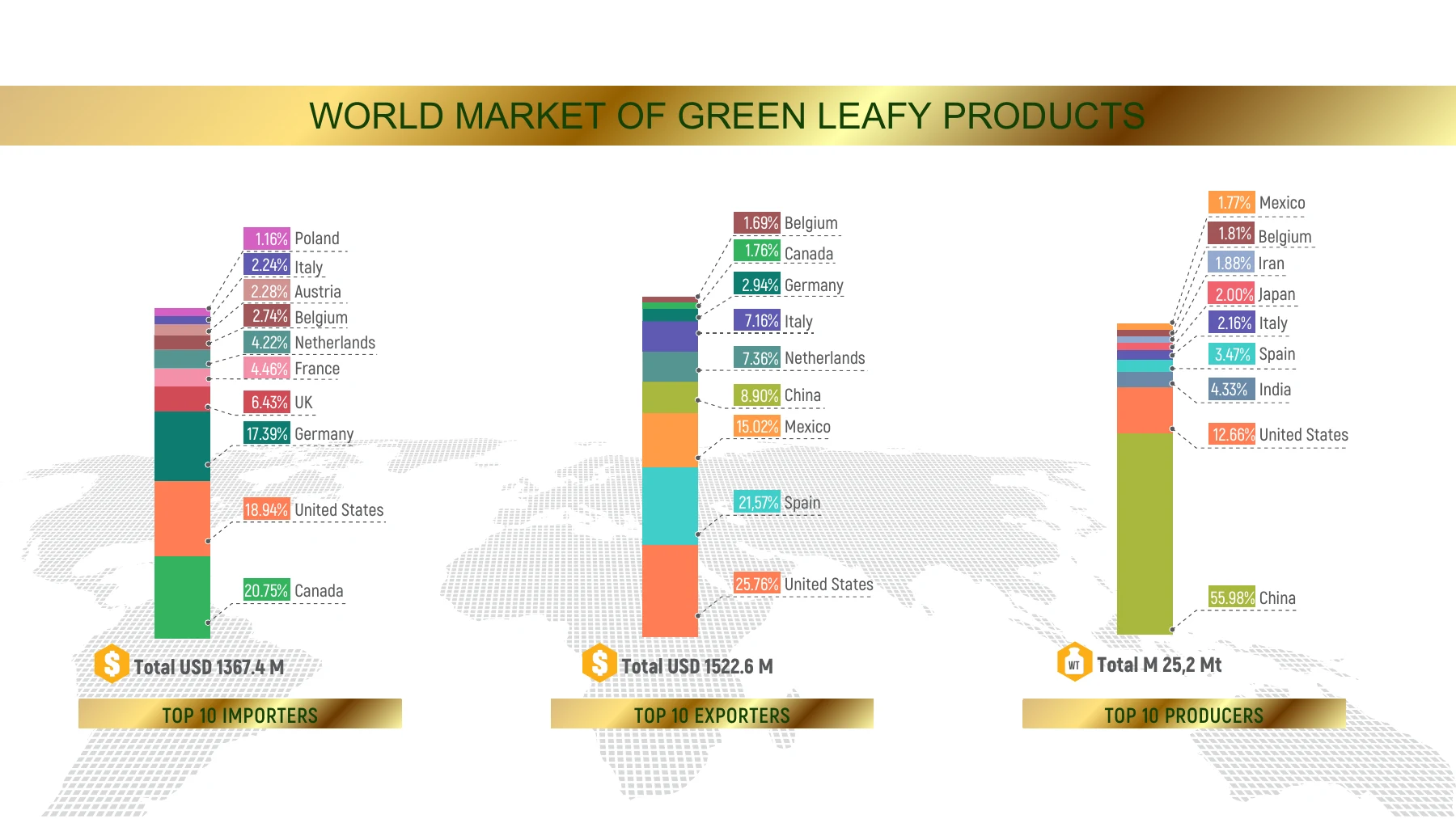
- Source totals: imports USD 1,367.4 million; exports USD 1,522.6 million; production 25.2 million tonnes.
- All visible country shares are reproduced below.
Import shares| Country | Share (%) |
|---|
| Canada | 20.75 |
|---|
| United States | 18.94 |
|---|
| Germany | 17.39 |
|---|
| UK | 6.43 |
|---|
| France | 4.46 |
|---|
| Netherlands | 4.22 |
|---|
| Belgium | 2.74 |
|---|
| Austria | 2.28 |
|---|
| Italy | 2.24 |
|---|
| Poland | 1.16 |
|---|
Export shares| Country | Share (%) |
|---|
| United States | 25.76 |
|---|
| Spain | 21.57 |
|---|
| Mexico | 15.02 |
|---|
| China | 8.9 |
|---|
| Netherlands | 7.36 |
|---|
| Italy | 7.16 |
|---|
| Germany | 2.94 |
|---|
| Canada | 1.76 |
|---|
| Belgium | 1.69 |
|---|
Production shares| Country | Share (%) |
|---|
| China | 55.98 |
|---|
| United States | 12.66 |
|---|
| India | 4.33 |
|---|
| Spain | 3.47 |
|---|
| Italy | 2.16 |
|---|
| Japan | 2 |
|---|
| Iran | 1.88 |
|---|
| Belgium | 1.81 |
|---|
| Mexico | 1.77 |
|---|
The slide says Top 10, but export and producer graphics each list nine countries. No missing tenth entry is invented. Observation year is unspecified.
Original slide & reference text
Original English transcript
Total USD 1367.4 M
Poland
Italy
Austria
Belgium
Netherlands
France
UK
Germany
United States
20.75%
18.94%
17.39%
6.43%
4.46%
4.22%
2.74%
2.28%
2.24%
Canada
1.16%
Total USD 1522.6 M
Belgium
Canada
Germany
Italy
Netherlands
China
Mexico
Spain
25.76%
21,57%
15.02%
8.90%
7.36%
7.16%
2.94%
1.76%
United States
1.69%
Total M 25,2 Mtwt
Japan
Spain
United States
55.98%
12.66%
India4.33%
3.47%
Italy2.16%
2.00%
Iran1.88%
Belgium1.81%
China
Mexico1.77%
TOP 10 IMPO RTERS TOP 10 E XPORTERS TOP 1 0 PRODUCERS
WORLD MARKET OF GREEN LEAFY PRODUCTS
CHAPTER 14
Spending on organic food
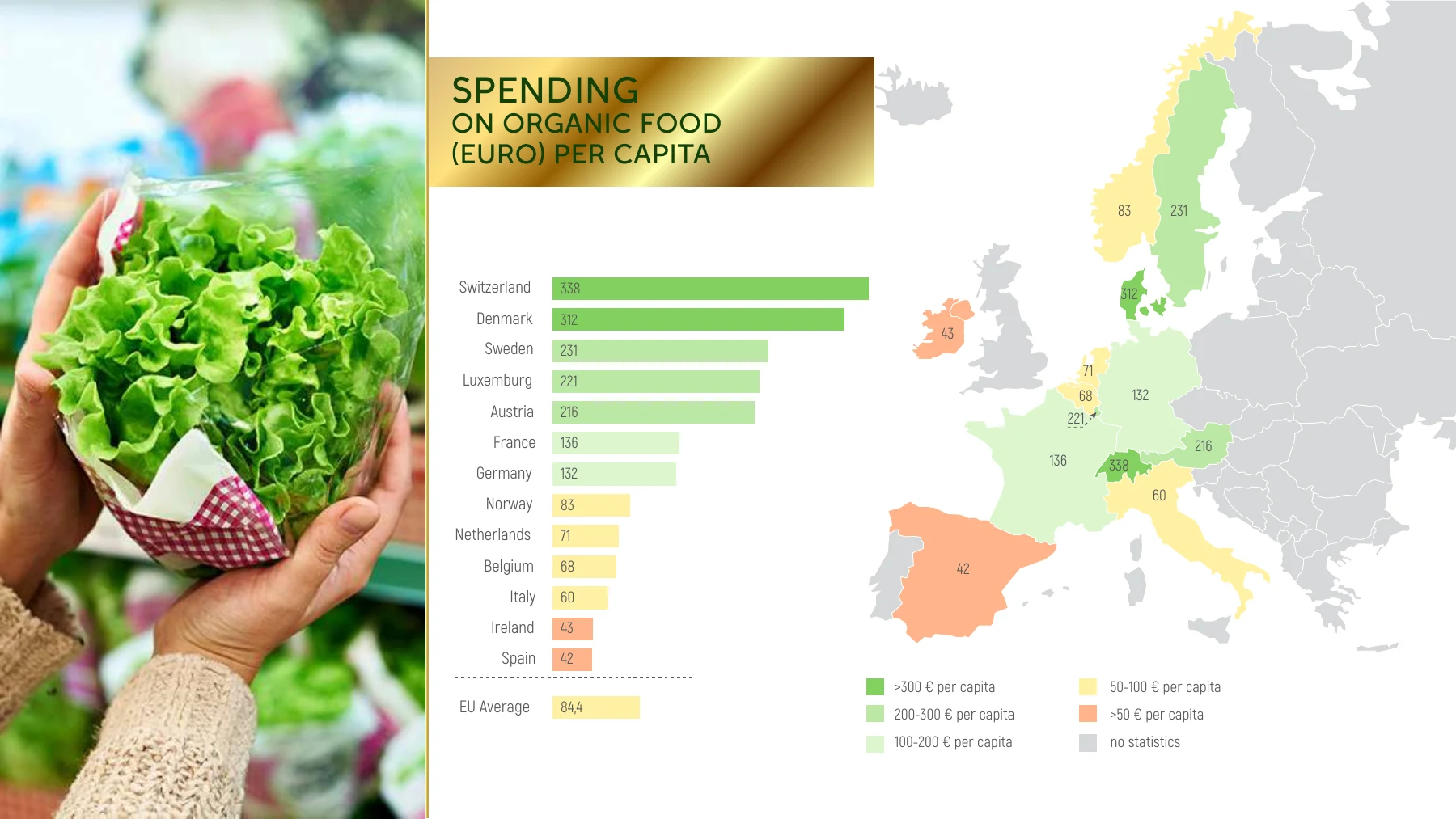
- The complete per-capita comparison and EU average are listed below.
- Map legend as printed: above EUR 300; EUR 200–300; EUR 100–200; EUR 50–100; >50; no statistics. The >50 label conflicts with the EUR 42 and EUR 43 countries shown in that colour.
Organic spending| Country / region | EUR per person |
|---|
| Switzerland | 338 |
|---|
| Denmark | 312 |
|---|
| Sweden | 231 |
|---|
| Luxembourg | 221 |
|---|
| Austria | 216 |
|---|
| France | 136 |
|---|
| Germany | 132 |
|---|
| Norway | 83 |
|---|
| Netherlands | 71 |
|---|
| Belgium | 68 |
|---|
| Italy | 60 |
|---|
| Ireland | 43 |
|---|
| Spain | 42 |
|---|
| EU average | 84.4 |
|---|
Observation year and underlying dataset are not stated.
Original slide & reference text
Original English transcript
338
312
23183
216
221
71
68
60
132
136
>300 € per capita 50-100 € per capita
200-300 € per capita >50 € per capita
100-200 € per capita no statistics
42
43
Switzerland
EU Average
Denmark
Sweden
Luxemburg
Austria
France
Germany
Norway
Netherlands
Belgium
Italy
Ireland
Spain
43
60
68
71
83
84,4
132
136
216
221
231
312
338
42
SPENDING
ON ORGANIC FOOD
EUR ER CAPITA
CHAPTER 15
Our technology
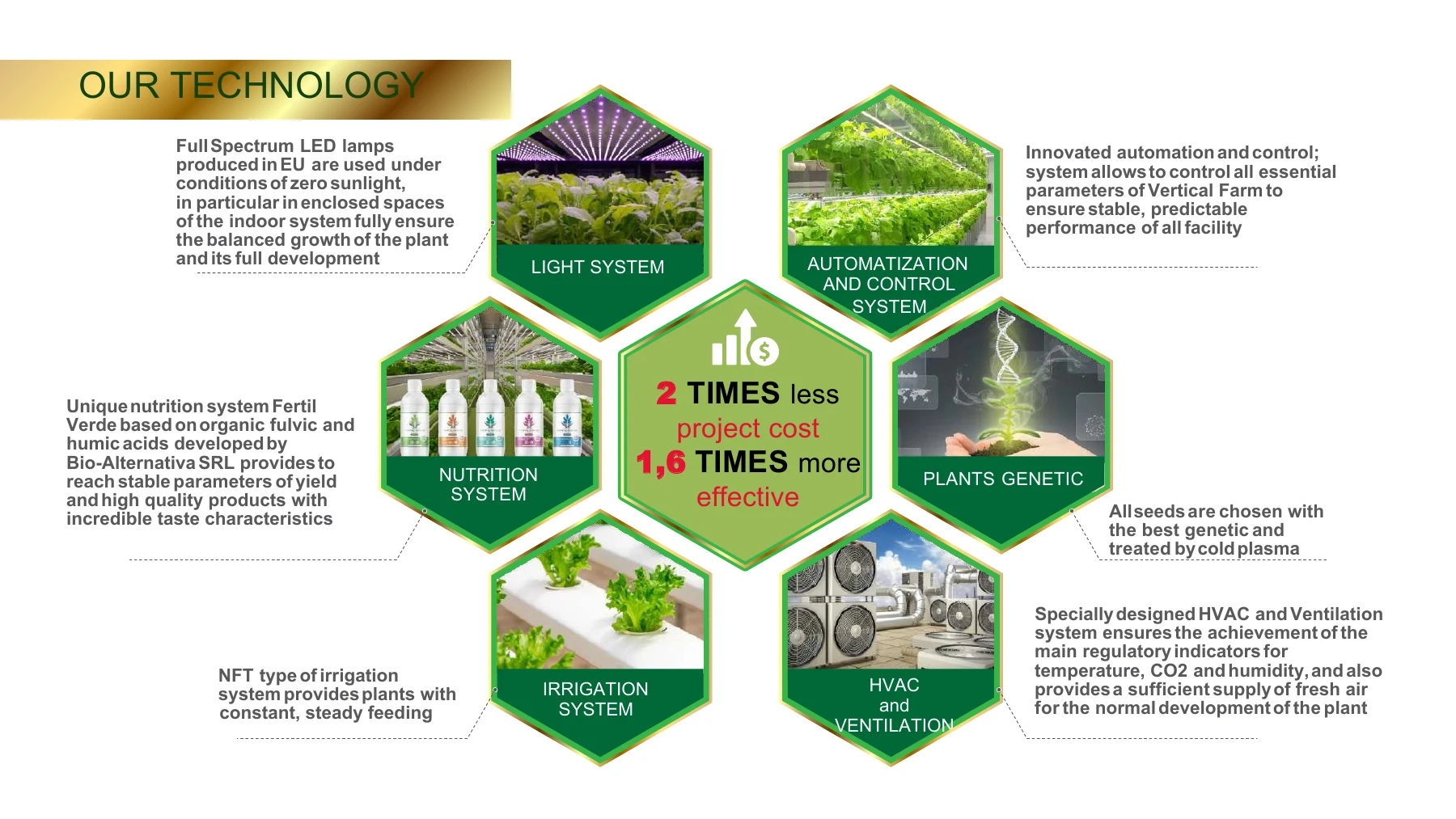
- EU-produced full-spectrum LED lamps support balanced growth in enclosed, zero-sunlight conditions.
- Automation manages essential farm parameters for stable, predictable performance.
- Selected seeds with the desired genetics are treated with cold plasma.
- Bio-Alternativa SRL developed Fertil Verde nutrition based on organic humic and fulvic acids, intended to support yield, quality and taste.
- HVAC and ventilation manage temperature, CO₂, humidity and fresh-air supply.
- NFT irrigation supplies constant, steady feeding.
- Claims: 2 times lower project cost and 1.6 times greater effectiveness.
The comparator, cost scope and definition of effectiveness are not specified.
Original slide & reference text
Original English transcript
2 TIMES less
project cost
1,6 TIMES more
effective
OUR TECHNOLOGY
FullSpectrum LED lamps
producedinEU are used under
conditionsof zerosunlight,
in particular inenclosed spaces
of the indoor system fully ensure
the balanced growthof the plant
and its full development LIGHT SYSTEM AUTOMATIZATION
AND CONTROL
SYSTEM
Innovated automationand control;
system allowsto control all essential
parameters of Vertical Farm to
ensure stable, predictable
performance of all facility
PLANTS GENETIC
Allseedsare chosen with
the best genetic and
treated bycoldplasma
Uniquenutrition system Fertil
Verde based onorganic fulvic and
humic acids developedby
Bio-Alternativa SRL providesto
reach stable parameters of yield
andhigh quality products with
incredible taste characteristics
NUTRITION
SYSTEM
Speciallydesigned HVAC and Ventilation
system ensuresthe achievementof the
main regulatoryindicators for
temperature, CO2 andhumidity,andalso
providesa sufficient supplyof fresh air
for the normal developmentof the plant
HVAC
and
VENTILATION
IRRIGATION
SYSTEM
NFT type of irrigation
system providesplants with
constant, steady feeding
CHAPTER 16
Farm concept and capacity
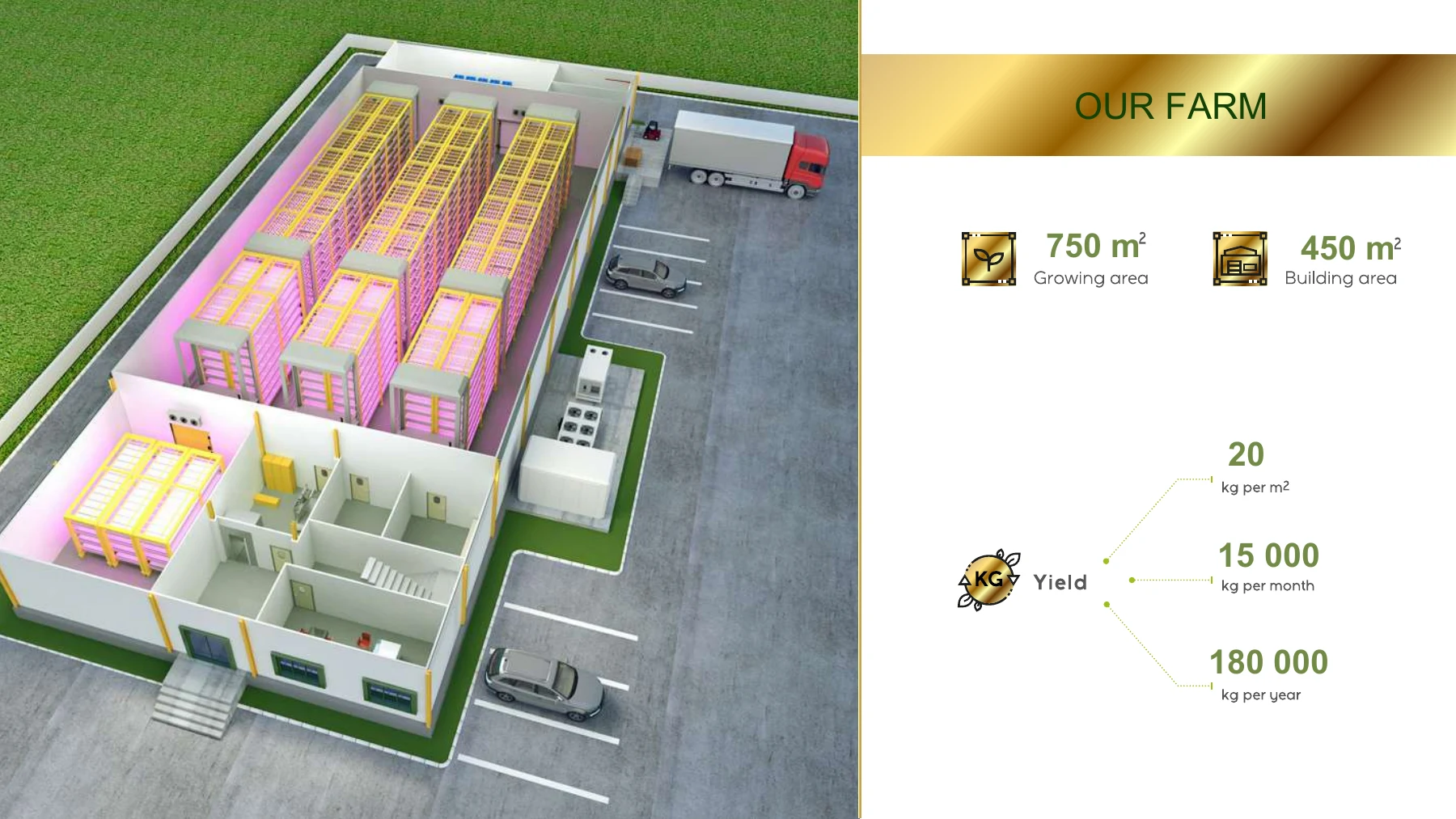
- The illustrated layout includes growing racks, service rooms, HVAC and loading access.
- Capacity figures are shown below.
Farm parameters| Parameter | Value |
|---|
| Growing area | 750 m² |
|---|
| Building area | 450 m² |
|---|
| Yield per growing area | 20 kg/m² |
|---|
| Monthly output | 15,000 kg |
|---|
| Annual output | 180,000 kg |
|---|
Concept figures, not confirmation of a built farm or realised output. The period for 20 kg/m² is not stated.
Original slide & reference text
Original English transcript
750 m 450 m
20
15 000
180 000
OUR FARM
CHAPTER 17
Crop range
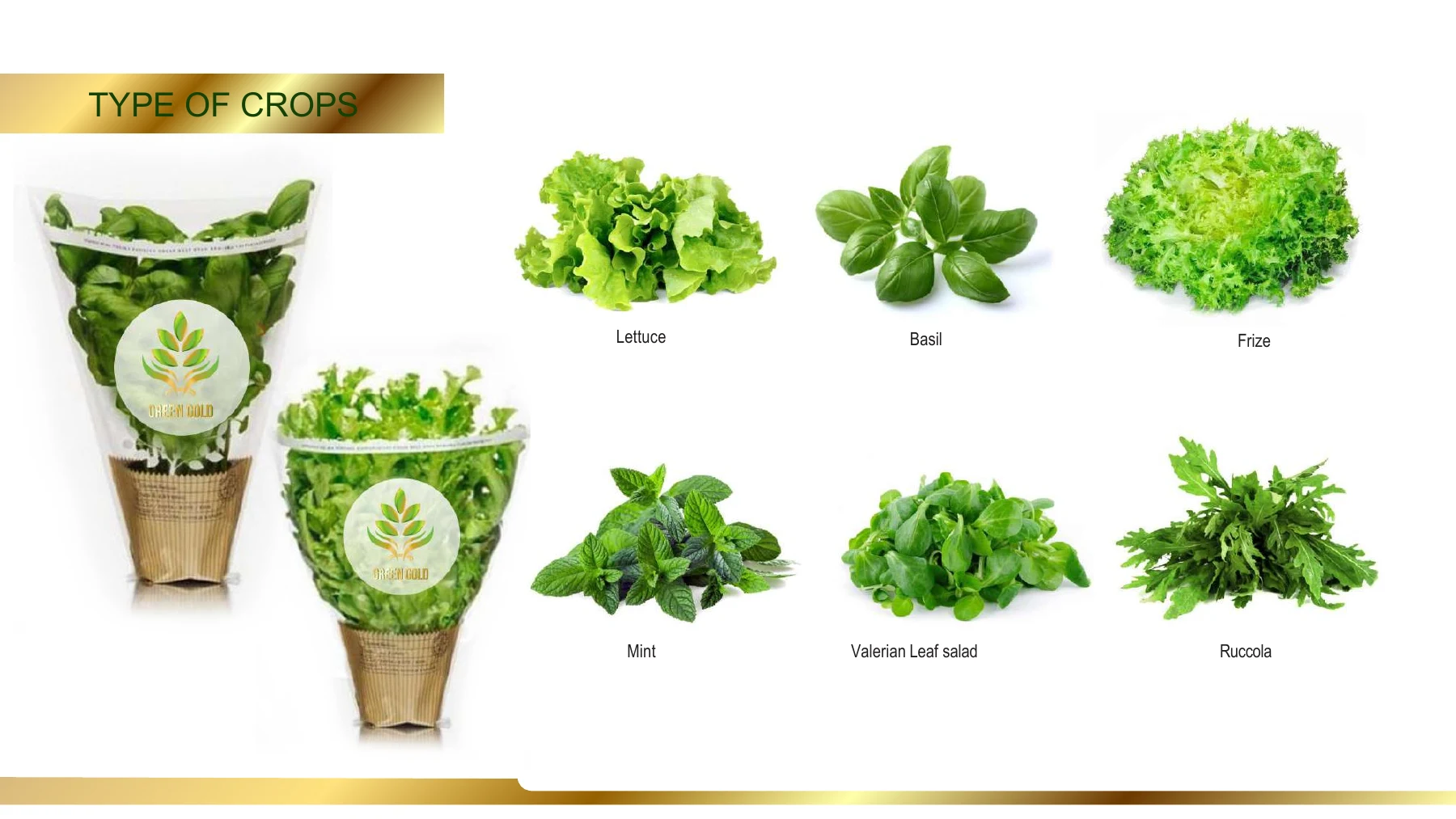
- Lettuce.
- Basil.
- Frisée (labelled Frize).
- Mint.
- Valerian (as labelled).
- Leaf salad.
- Rocket / arugula (labelled Ruccola).
The source says Valerian without a botanical species; it has not been silently relabelled.
Original slide & reference text
Original English transcript
Lettuce Basil Frize
Mint Valerian Leaf salad Ruccola
TYPE OF CROPS
CHAPTER 18
Strategic development plan
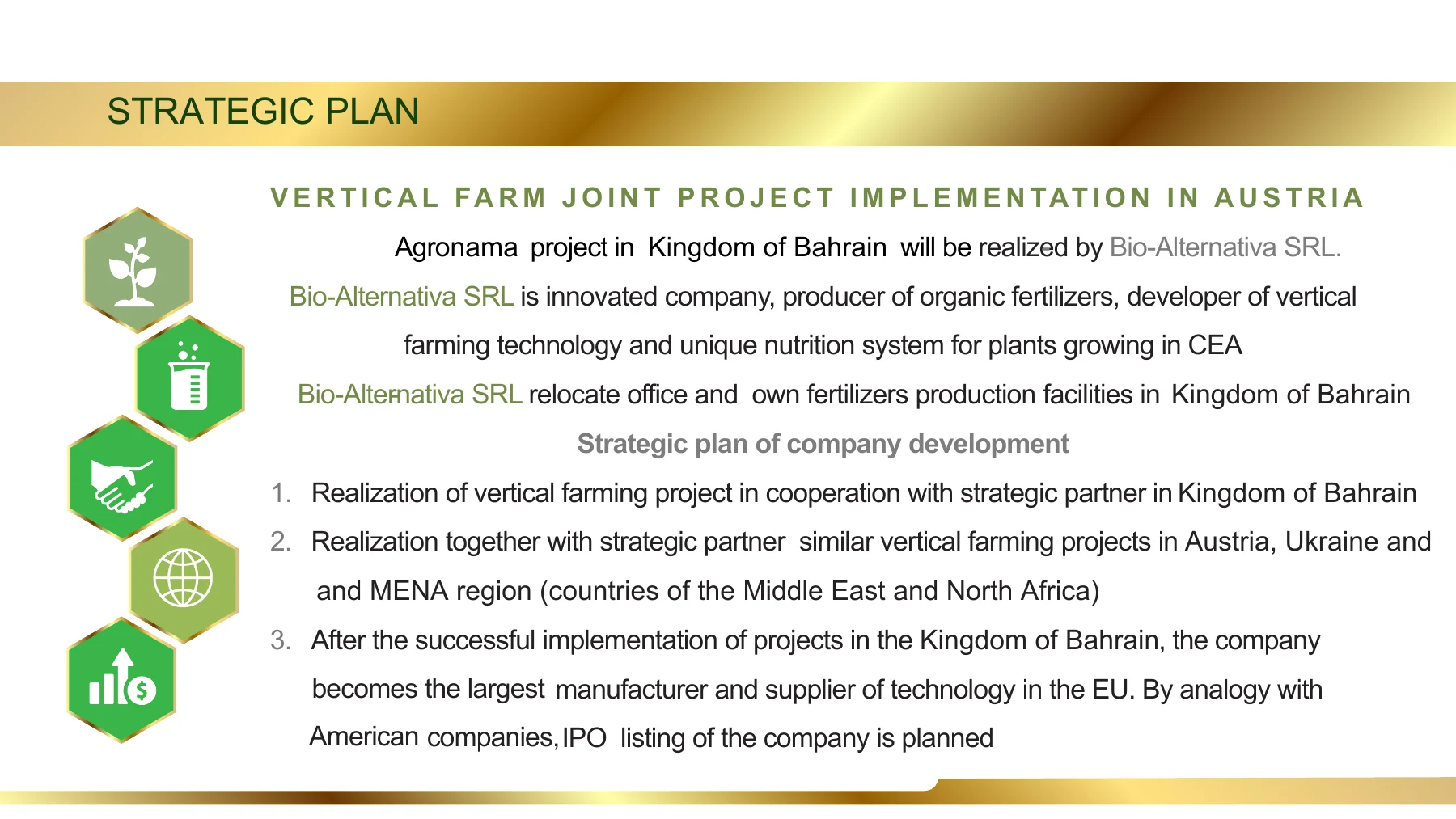
- Bio-Alternativa SRL is described as an innovative organic-fertilizer producer and developer of vertical farming and CEA nutrition.
- It is to implement the Bahrain AGRONAMA project, with a planned relocation of its office and own fertilizer production to Bahrain.
- Stage 1: a Bahrain vertical-farming project with a strategic partner.
- Stage 2: similar partner projects in Austria, Ukraine and MENA.
- Following successful Bahrain projects, the stated ambition is to become a leading EU manufacturer and technology supplier, with an eventual IPO by analogy with American companies.
- The slide also carries the heading Vertical farm joint project implementation in Austria.
Plans, not confirmed milestones. No completion dates, relocation confirmation or IPO schedule are supplied.
Original slide & reference text
Original English transcript
1. Realization of vertical farming project in cooperation with strategic partner in
2. Realization together with strategic partner similar vertical farming projects in Austria, Ukraine and
and MENA region (countries of the Middle East and North Africa)
3. After the successful implementation of projects in the Kingdom of Bahrain, the company
becomesthe largest manufacturerand supplier of technology in the EU. By analogy with
American companies,IPO  listing of the companyis planned
STRATEGIC PLAN
V E R T I C A L  FA R M  J O I N T  P R O J E C T  I M P L E M E N TAT I O N  I N  A U S T R I A
Agronama project in Kingdom of Bahrain will be realized by- Alternativa SRL.
Bio-Alternativa SRL is innovated company, producer of organic fertilizers, developer of vertical
farming technology and unique nutrition system for plants growing in CEA
Bio- -Alternativa SRL relocate office and own fertilizersproduction facilities in Kingdom of Bahrain
Strategic plan of company development
Bio-
Kingdom of Bahrain
CHAPTER 19
Thank you
- The presentation closes with Thank you for attention and AGRONAMA visual branding.
Original slide & reference text
Original English transcript
THANK YOU FOR ATTENTION
 AGRONAMA